Showing posts with label Rule Books. Show all posts

Thursday, 12 August 2010

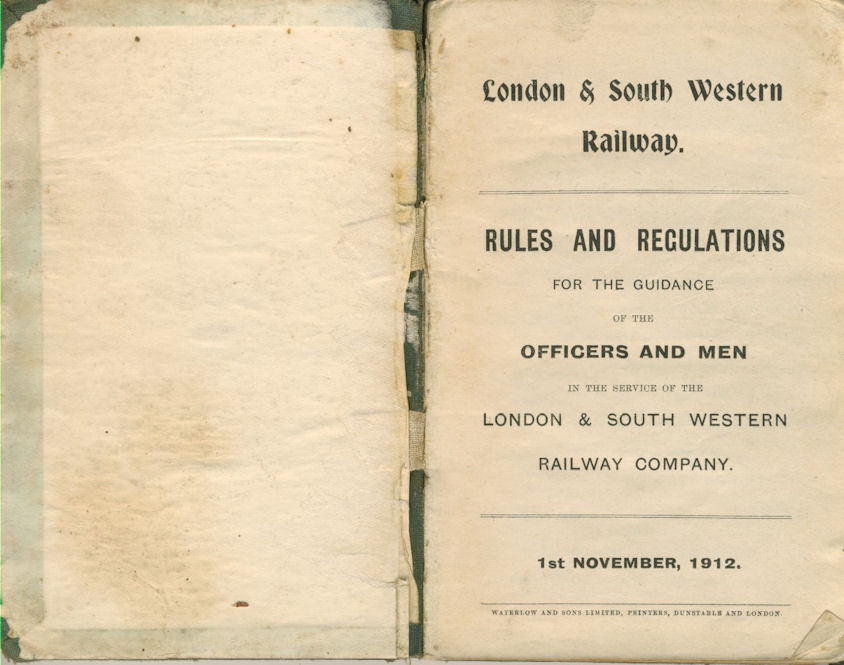
L&SWR Rule Book - 1912

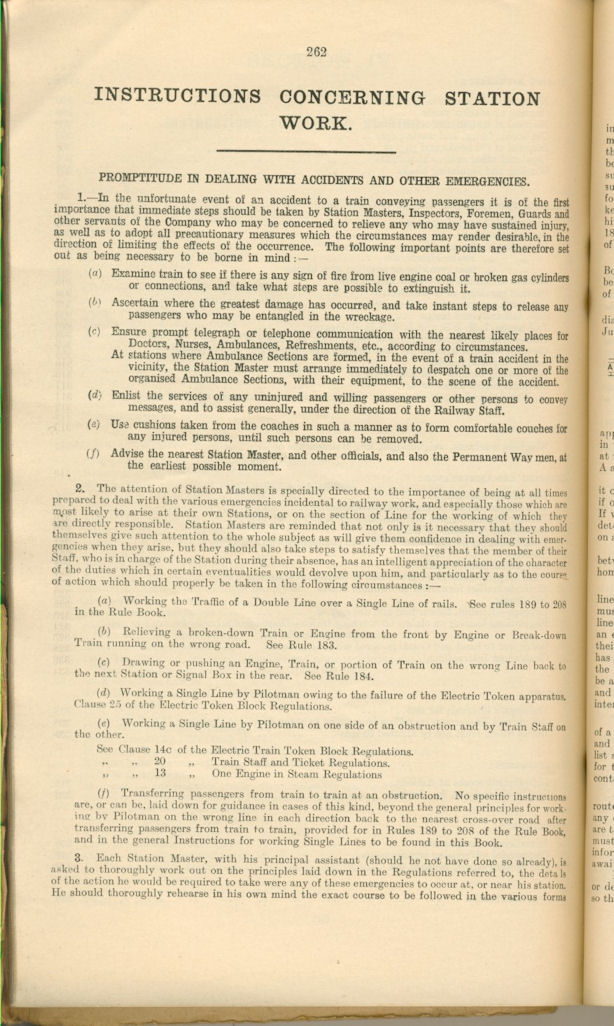
On the 9th August 1912, the Board of the London and South Western Railway approved this new rule book. By the looks of it, this was simply an updated version of the company's 1904 rule book. Additionally this, in its turn, was a predecessor to the company's 1921 rule book. In fact, the three books are so alike that without the dates on the front it would be hard to determine which was which. Contrast this with rule books from 1864 and 1884, and it is clear to see that this similarity indicates that by the early 20th century the procedures within the industry had become very ingrained. As such, the rule book, the most fundamental element of the railwayman's life, is highly representative of the stage that the railways were at in their development.


Saturday, 7 August 2010

L&SWR instructions to Engineering Staff - 1896 (From Other Turnip Rail Site)

This is another rule book for L&SWR staff that in a sense shows the division between the different departments within the company. While the main company Rule Book was issued to all staff, the one shown was an extra one supplied to the staff in the Engineering Department. This was issued in 1896, however a more wide-ranging one was issued in 1902 that also covered regulations regarding the maintenance and operation of signals. What they both evidence is the fact that the Engineering department required extra rules and regulations pertinent to their own operations. On the other hand, the Traffic and Running Departments had their own 'Appendix to the working timetable' which detailed their own 'extra' rules and regulations. Thus, the departments by the late 1890s had grown apart to become organisations in their own right. Thus this example and the 1902 instruction book were formulated in isolation by the department chiefs, as a comprehensive common rule book could not be formulated for all departments. I have shown all the pages here so please click on them to take a better look.


Friday, 6 August 2010

Handbook for Railway Steam Locomotive Firemen - 1957

I'm afraid that it would be impossible for me to do complete justice to this book on this site as it is 194 pages long and containing many images and diagrams of parts of locomotives. It is, however, interesting because it basically describes the operation of Britain's last generation of steam locomotives. Further, it would have been issued to Britain's last generation of Steam Engine drivers, as by this time the first moves were being made towards modernisation. Thus, it is one of the last paper relics from the era of steam. It does, however, show how far steam engine technology had developed up until that point.


Thursday, 5 August 2010

Great Northern Railway - 'General Instructions Relating to Merchandise Traffic' - 1899

Until I did an extended search on the web found me the answer, this book's origins were a mystery to me. It is rare to find an item from the Victorian Railway that has a complete lack of information on its origins. So, there is no company stamp on it, and even no details in the text as to what company it was from. This is simply weird, especially as companies in the period had their names emblazoned on almost everything. Eventually, I did find what I think is the answer through an on-line catalogue of documents.

It is, however, interesting that the Great Northern Railway (GNR) felt the need to issue a separate instruction book regarding goods traffic. It reflects the fact that the bulk of the GNR's income came from the flow of goods and that more regulations were required to monitor the service. Comparatively, I do not think that the London and South Western Railway ever felt the need to issue a separate booklet for merchandise traffic, reflecting its smaller role in the company's profits. It would seem that the what supplementary rule books companies issued, depended a great deal on the traffic and operational environment.


SR Rules and Instruction Applicable to Electrified Lines - 1933 (from main Turnip Rail website)

This little book is a mere 50 pages long and was issued to all the Southern Railway's staff who worked on their electric services. It came into force on the 1st January 1933 and contained sections of both the general company rule book and the Appendix to the working timetable. With the largest electrified network of the 'Big Four' railway companies, it is unsurprising that the SR deemed it necessary to issue a unique rule book for the electric staff. This said, the London, Midland and Scottish Railway also released their separate rule book for the staff working electric services in 1937. What, however, this document shows is that by the Mid-1930s there were swathes of rules and regulations across the railway industry, so much so that many did not apply to some staff. After all, with no goods services being run by electric trains all the rules and regulations that applied to those services did not need to be learnt by the electric staff in detail, if at all. Therefore, it was presumably much more convenient for the staff to have a dedicated rule book for themselves. This would be a more efficient method of distributing the regulations that issuing each member of staff with the full, more bulky, rule book. I imagine it also cut printing costs...

My favourite image is the last, which showed how to resuscitate someone who had been electrocuted. Simply put, the image shows a very basic version of CPR under the heading, 'Method of Conducting Artificial Respiration.' The instructions were as follows: 'Kneel at one side of, or across the patient, and, without violence, produce a firm, steady, downward pressure (see Fig.1 on page 50). Next release all pressure by swinging your body backwards without lifting your hands from the patient (see Fig 2 on page 50).' I wonder how many times this was required, and how effective it was?


Tuesday, 3 August 2010

Great Western Appendix to the Rule Book - 1936

Now as some of you might be aware I am not the world's biggest fan of the Great Western Railway. I dunno what it is, but I have never really warmed to the company. It's nothing personal, I suppose it's like my feelings about boiled potatoes, I don't hate them, I can tolerate them, but I wouldn't choose them. However, yesterday I received this item through the post, a GWR 'General Appendix to the Rule Book' that came into force on the 31st of August 1936. I bought it off ebay so I could compare it with the Southern Railway's Appendix from 1934.

While I have not had time to really digest the document, it is clear that it is very, very different to the the Southern Railway's product. They are about the same length, but what is interesting is that the Southern railway's offering is peppered with instructions regarding single locations or stations, something that is very absent from the GWR appendix. Indeed, remove this material from the Southern Railway Appendix, and the book is much smaller. Therefore, the GWR is much denser in content, with far more rules and regulations. Perhaps the GWR was a much stricter railway to work for? Now, it could be argued that because the GWR was a larger network that it required more regulations. But what the GWR Appendix presents are rules for general and universal consumption irrespective of location. Therefore, this to an extent eliminates the argument that there are many more rules because of its size. Of course this is a only an opinion formed with a few glances through, but it is an interesting proposition, especially when considering that many elements of the railway operation and procedure had by this time had been standardised across all the companies.