Showing posts with label London and South Western Railway. Show all posts

Thursday, 12 August 2010

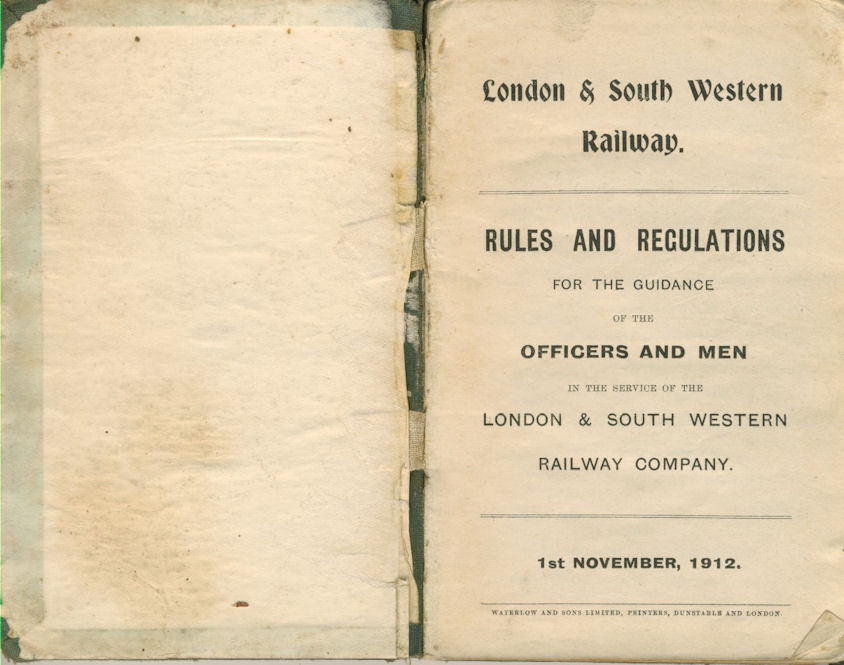
L&SWR Rule Book - 1912

On the 9th August 1912, the Board of the London and South Western Railway approved this new rule book. By the looks of it, this was simply an updated version of the company's 1904 rule book. Additionally this, in its turn, was a predecessor to the company's 1921 rule book. In fact, the three books are so alike that without the dates on the front it would be hard to determine which was which. Contrast this with rule books from 1864 and 1884, and it is clear to see that this similarity indicates that by the early 20th century the procedures within the industry had become very ingrained. As such, the rule book, the most fundamental element of the railwayman's life, is highly representative of the stage that the railways were at in their development.


Wednesday, 11 August 2010

L&SWR Gradient manual - 1887

Gradient manuals of this type were issued to all engine drivers on the L&SWR. This one from 1887 is presumably the last (or first) type that was issued as the inside cover, shown below, are written the men that used it. First there was engineman J. Meaton who was based at Northam and was presented it in 1887. However, it was eventually passed to A. Plummer, presumably a driver at Nine Elms, in April 1930. This indicates that this document was used for over 40 years by these men, but also that a replacement was not issued either by the London and South Western Railway, or its successor, the Southern Railway. This was despite many more lines being opened. It is, therefore, quite possible that these men were main line drivers, as if they were driving on any of the new lines that were constructed after 1887 (all branch, light or secondary lines), the companies would have be required to issue a new gradient manual.


Saturday, 7 August 2010

L&SWR instructions to Engineering Staff - 1896 (From Other Turnip Rail Site)

This is another rule book for L&SWR staff that in a sense shows the division between the different departments within the company. While the main company Rule Book was issued to all staff, the one shown was an extra one supplied to the staff in the Engineering Department. This was issued in 1896, however a more wide-ranging one was issued in 1902 that also covered regulations regarding the maintenance and operation of signals. What they both evidence is the fact that the Engineering department required extra rules and regulations pertinent to their own operations. On the other hand, the Traffic and Running Departments had their own 'Appendix to the working timetable' which detailed their own 'extra' rules and regulations. Thus, the departments by the late 1890s had grown apart to become organisations in their own right. Thus this example and the 1902 instruction book were formulated in isolation by the department chiefs, as a comprehensive common rule book could not be formulated for all departments. I have shown all the pages here so please click on them to take a better look.


Thursday, 5 August 2010

Royal Train Timetable - 1898/1909 (From Other Turnip Rail Site)

These really interesting documents detail the journey of Royal trains on the London and South Western Railway. These documents were presumably given out along the routes of the trains so that people could observe the royal trains if they so desired. The first document was given out on the occasion of Edward VII's journey from Waterloo to Farnborough and his return from Aldershot to Waterloo on 18th May 1909. The reason for the destination and departure stations being different is that he toured various military bases in the region on the day. The second document has a more detail in that the entire timetable is shown. It was issued on occasion of Queen Victoria's journey from Windsor to Portsmouth on the 10th March 1898, where she boarded the Royal Yacht for a holiday in the south of France. These very grand documents do have gold printed on them, so they couldn't have been cheap for the company to produce. But, in an era of patriotic fervour a little extra expense probably wasn't minded.

Wednesday, 4 August 2010

Material Supply Notes - 1911/12 (from Turnip Rail Main Site)

These are London and South Western Railway material supply notices from 1912 and 1911 that I originally posted on my other site. I am unsure exactly how they worked by I suspect that they went with the supplies when they were sent to their destinations. Obviously, however, the forms were designed to be attached to only one item, however, on both the documents the supplies were obviously sent to multiple destinations. Possibly, they had 1000s of these things in this period and were exhausting the supply before designing a new form. As for some of the names on the forms, on the first it is signed 'S[urrey]. Warner.' He was the L&SWR's Carriage and Wagon Superintendent between 1906 and 1923. On the second are two names. The first is Gilbert Szlumper, who was at that point a 1st Class Engineering Assistant at Eastleigh and the second is O[sborne].A[nthony].G[eorge]. Edwards, who was at that point the Central District Engineer.

L&SWR Guard's Log Book 1910's

This is actually a blank book, unused by the London and South Western. This Guard's Log book, printed in the 1910s at some point, is surprisingly similar to a Southern Railway version that I presented a few days ago. What this means is that in the period between, at most, 1919 and 1939, the stationary provided to railway staff altered very little. Therefore, it suggests that at least one procedure, was unaltered by the creation of the Big 4 in 1923.

Monday, 2 August 2010

L&SWR Accounts Department Circular on parcels traffic 1912

One of the features of the 19th century railway company was that the departments became institutions in their own right. Of course, within this framework the smaller departments conformed to the paradigm of being independent as they were surrounded by the bigger ones who also were in the same organisational position, even if it was on a grander scale. Therefore the Accounts department of the London and South Western Railway (L&SWR) was an independent operating unit and as such conformed to paradigms of action laid down by the other departments. What is shown above and below is an Accounts Department circular sent out in 1912 by the department. It is almost identical to the other departments' circulars of the period and therefore suggests that across the departments there were norms of organisational behaviour. However, the fact that it was sent out from the department, but with some input from the Superintendent of the Line, suggests that the traditional barriers that had been established between departments were, in some cases, broken down when required.