Showing posts with label Southern Railway. Show all posts

Sunday, 8 August 2010

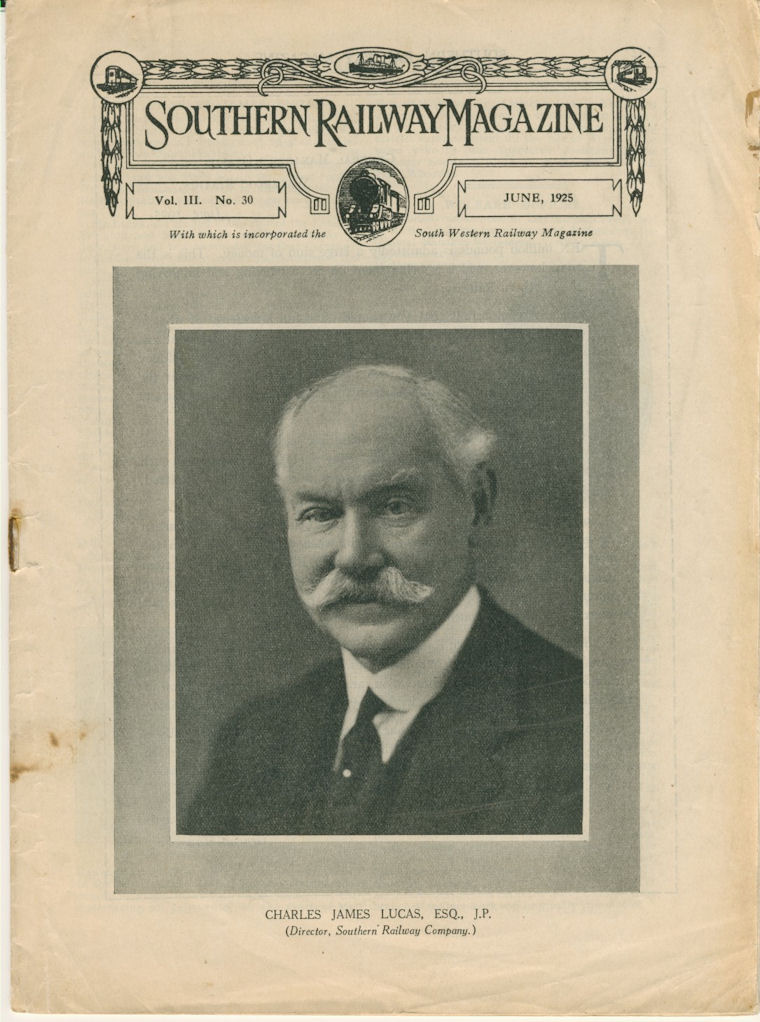
Southern Railway Magazine - 1925

The Southern Railway Magazine (SRM), the staff magazine of the Southern Railway (SR), was essentially a later version of the first railway company staff magazine, the South Western Gazette (SWG), that was independently published for the London and South Western Railway's staff from 1881. This became the South Western Magazine (SWM) in 1916 and it is this title that is shown on the top of the SRM's cover above. On the grouping, the magazine was from thereon published with all of the SR's staff in mind, the other constituent companies not having established their own staff magazines before 1922. This said, it still maintained for many years a bias towards events taking place in the old L&SWR territories.

Where it differed from it's forerunner, the SWG and for two years the SWM, was that the SRM was owned by the company as the SWM had been taken over by the L&SWR management in 1918. This meant that SRM's content was far more in line with the needs of the management to inform and instruct the workforce, whereas its forerunners were much less inclined to explicitly project any of management's views.


Thursday, 5 August 2010

SR Rules and Instruction Applicable to Electrified Lines - 1933 (from main Turnip Rail website)

This little book is a mere 50 pages long and was issued to all the Southern Railway's staff who worked on their electric services. It came into force on the 1st January 1933 and contained sections of both the general company rule book and the Appendix to the working timetable. With the largest electrified network of the 'Big Four' railway companies, it is unsurprising that the SR deemed it necessary to issue a unique rule book for the electric staff. This said, the London, Midland and Scottish Railway also released their separate rule book for the staff working electric services in 1937. What, however, this document shows is that by the Mid-1930s there were swathes of rules and regulations across the railway industry, so much so that many did not apply to some staff. After all, with no goods services being run by electric trains all the rules and regulations that applied to those services did not need to be learnt by the electric staff in detail, if at all. Therefore, it was presumably much more convenient for the staff to have a dedicated rule book for themselves. This would be a more efficient method of distributing the regulations that issuing each member of staff with the full, more bulky, rule book. I imagine it also cut printing costs...

My favourite image is the last, which showed how to resuscitate someone who had been electrocuted. Simply put, the image shows a very basic version of CPR under the heading, 'Method of Conducting Artificial Respiration.' The instructions were as follows: 'Kneel at one side of, or across the patient, and, without violence, produce a firm, steady, downward pressure (see Fig.1 on page 50). Next release all pressure by swinging your body backwards without lifting your hands from the patient (see Fig 2 on page 50).' I wonder how many times this was required, and how effective it was?


Sunday, 1 August 2010

Southern Railway Guard's Log Book - 1939-51

This is something that came into my possession about 6 months ago and is the journey log of a Southern Railway goods guard, G. Rowe, who was based at Guildford. It covers the period between April 1939 and July 1951. The log is interesting because it covers the six years of World War Two and shows the effect that the war had on rail transportation in the country. Rowe was required to detail every journey he made in the book, noting down the time he arrived at every station and passed major landmarks such as junctions. He also recorded how late the train was. In the pre-war period he was was only occasionally late, and even then only by a few minutes. However in wartime, be it because of unusual train operations, bombing or low staffing levels, his trains were almost never on time. Below, I have scanned two pages. The first is from 22nd July 1939, when Rowe's train was on time. However, in the second scan, dated the 30th January 1940, he was 105 minutes late arriving at Ascot.